
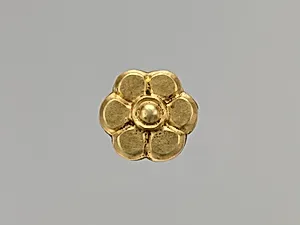
Flower-Shaped Plaque
Unknown Artist
7th–9th century
Medium
Gold
Dimensions
Diam. 5/8 in. (1.6 cm)
Classification
Metalwork
Culture & Period
China (Xinjiang Autonomous Region, Central Asia) · Period of Tibetan Empire
Department
Asian Art
Museum
Metropolitan Museum of Art, New York, NY
Credit
Purchase, Friends of Asian Art Gifts, 2003
Accession Number
2003.24.22
Rights
Public Domain
Art Historical Context
This exquisite Flower-Shaped Plaque, crafted from gleaming gold in 7th–9th century China’s Xinjiang Autonomous Region, offers a window into the vibrant cultural crossroads of Central Asia during the Period of Tibetan Empire. Measuring just 5/8 inch (1.6 cm) in diameter, this tiny metalwork treasure—likely a decorative ornament for clothing, jewelry, or personal adornment—captures the floral motifs that symbolized beauty, prosperity, and renewal across Eurasian traditions. Unearthed from a region along ancient Silk Road trade routes, the plaque reflects the Tibetan Empire's expansive influence (roughly 618–842 CE), when Central Asian artisans blended local techniques with Tibetan, Chinese, and even Persian styles. Gold, a precious and malleable medium, was hammered and possibly repoussed to form the intricate flower shape, showcasing masterful metalworking skills that required precision on such a miniature scale. Its survival highlights the era's sophisticated craftsmanship amid political dynamism. Today, this artifact graces the Metropolitan Museum of Art’s Asian Art Department, acquired through the generosity of the Friends of Asian Art in 2003. It reminds us how small objects like this plaque wove together distant worlds, preserving echoes of a thriving, interconnected past.