
Flute
Unknown Artist
9th century
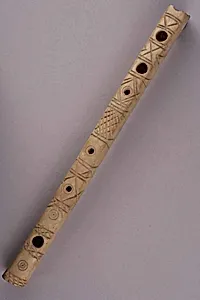
Medium
Bone; incised
Dimensions
H. 11/16 in. (1.7 cm) W. 1/2 in. (1.2 cm) LengtH. 6 7/8 in. (17.5 cm) 3 holes Diam. 1/4 in. (0.6 cm), 3 holes 1/2 in. (1.3 cm)
Classification
Ivories and Bone
Department
Islamic Art
Museum
Metropolitan Museum of Art, New York, NY
Credit
Rogers Fund, 1938
Accession Number
38.40.239
Rights
Public Domain
Tags
Art Historical Context
This 9th-century bone flute, attributed to an unknown artist, represents a rare surviving example of early Islamic instruments. Measuring just 6 7/8 inches long with three incised holes, the object was carved from bone and decorated through incision, a technique that allowed artisans to add subtle ornamentation to everyday or ceremonial items. Its small scale suggests it was designed for personal use, perhaps in intimate settings within the Abbasid-era cultural sphere. Classified under Ivories and Bone in the Metropolitan Museum’s Department of Islamic Art, the flute highlights the period’s appreciation for finely worked natural materials. Bone offered both durability and a smooth surface for carving, making it ideal for portable instruments that combined functionality with aesthetic appeal. Though the artist remains unidentified, the careful placement of holes of differing diameters indicates practical knowledge of acoustics alongside decorative skill. Such artifacts provide insight into the role of music in 9th-century Islamic societies, where instruments like flutes contributed to courtly entertainment and daily life. Acquired by the museum through the Rogers Fund in 1938, this piece invites visitors to consider how even modest objects carried artistic and cultural significance across centuries.