
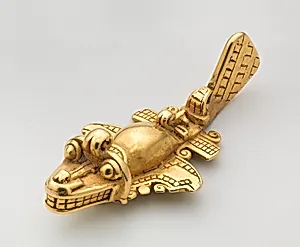
Flying-Fish Pendant
Unknown Artist
10th–15th century
Medium
Gold
Dimensions
H. 5/8 in. × W. 1 in. × D. 2 1/8 in. (1.6 × 2.5 × 5.4 cm)
Classification
Metal-Ornaments
Culture
Tolima (?)
Department
Arts of Africa, Oceania, and the Americas
Museum
Metropolitan Museum of Art, New York, NY
Credit
The Michael C. Rockefeller Memorial Collection, Bequest of Nelson A. Rockefeller, 1979
Accession Number
1979.206.782
Rights
Public Domain
Tags
About this artwork
This flying-fish pendant is a pre-Columbian gold ornament attributed to the Tolima culture of Colombia, dating to the 10th-15th century (900-1500 CE). The piece exemplifies sophisticated metalworking traditions of ancient Andean societies in the Magdalena Valley region. The pendant depicts a stylized flying fish in hammered gold with sharp, symmetrical outlines and an almost flat profile. The zoomorphic form features characteristic Tolima design elements including abstracted fins, tail, and hea...
Art Historical Context
This exquisite Flying-Fish Pendant, crafted from hammered gold by an unknown artist of the Tolima culture (or related group) in Colombia between the 10th and 15th centuries, showcases the mastery of pre-Columbian metalworkers in the Magdalena Valley. Measuring just 5/8 by 1 by 2 1/8 inches, the small ornament depicts a stylized flying fish with sharp, symmetrical outlines, abstracted fins, tail, and head forming a balanced, almost flat silhouette. A suspension loop reveals it was likely worn as a necklace, blending zoomorphic grace with technical precision. Tolima goldwork is renowned for its consistency in form across centuries, often merging animal and human elements tied to cosmology. Techniques like hammering, lost-wax casting, and annealing allowed artisans to create delicate yet durable pieces, as seen in over 100 similar artifacts preserved worldwide, including Colombia's Museo del Oro. Discovered in a grave near San Agustín—high in the Andes, far from Pacific coasts—this pendant hints at profound ritual or elite status, symbolizing perhaps mythical sea creatures vital to Tolima beliefs. Part of The Metropolitan Museum of Art's Michael C. Rockefeller Memorial Collection, it embodies the enduring legacy of Andean artistry.