
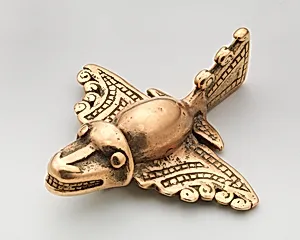
Flying-Fish Pendant
Unknown Artist
10th–15th century (?)
Medium
Gold
Dimensions
H. 5/8 × W. 1 3/4 × D. 1 3/4 in. (1.6 × 4.4 × 4.4 cm)
Classification
Metal-Ornaments
Culture
Tolima (?)
Department
Arts of Africa, Oceania, and the Americas
Museum
Metropolitan Museum of Art, New York, NY
Credit
Jan Mitchell and Sons Collection, Gift of Jan Mitchell, 1991
Accession Number
1991.419.24
Rights
Public Domain
Tags
Art Historical Context
This exquisite Flying-Fish Pendant, crafted from gold between the 10th and 15th centuries, showcases the remarkable skill of ancient metalworkers from the Tolima region. Measuring just over an inch and a half wide, the delicate ornament captures the graceful form of a flying fish with stylized fins and a streamlined body. Its compact size suggests it was designed to be worn, likely as a personal adornment signifying status or spiritual connection. Gold held profound importance in the ancient Americas, valued not only for its luminous beauty but also for its symbolic ties to the sun and divine power. Artisans employed sophisticated techniques such as hammering and possibly lost-wax casting to achieve the pendant’s fine details, reflecting a deep cultural reverence for natural forms. Though the precise meaning remains elusive, the choice of a flying fish hints at themes of transformation between water and sky. Acquired by the Metropolitan Museum through the Jan Mitchell and Sons Collection, this piece offers visitors a window into the sophisticated artistic traditions of pre-Columbian societies. Its presence in the Arts of Africa, Oceania, and the Americas galleries highlights the enduring legacy of these early goldsmiths.