
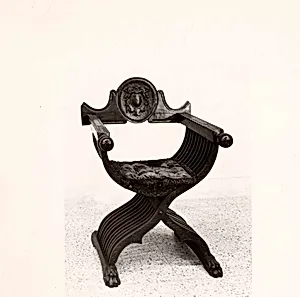
Folding armchair (sedia a Savonarola type)
Unknown Artist
15th century (textile); 19th century (chair, with earlier parts)
Medium
Walnut, turned and carved; silk
Dimensions
H. approx. 98.2 cm, W. 64 cm, D. 55.2 cm; Cushion: 36 x 40 cm.
Classification
Textiles-Velvets|Woodwork-Furniture
Culture
Italian
Department
Robert Lehman Collection
Museum
Metropolitan Museum of Art, New York, NY
Credit
Robert Lehman Collection, 1975
Accession Number
1975.1.1987 ab
Rights
Public Domain
Art Historical Context
Step into the elegance of Renaissance Italy with this folding armchair, as a *sedia a Savonar*. Exemplifying a classic X-frame design that folds for portability, it stands about 98 cm tall, crafted from walnut that's expertly turned and carved for both strength and ornamentation. The seat cushion, upholstered in luxurious 15th-century silk velvet, adds a touch of opulence, measuring 36 x 40 cm—perfect for a noble's repose or travel. Dating to the 19th century for the chair frame (with earlier incorporated parts), this piece bridges centuries of Italian craftsmanship. The walnut's turning technique—shaping wood on a lathe—creates slender, rhythmic supports inspired by ancient Roman models, while the carved details evoke the refined aesthetics of the Renaissance. The silk textile, a hallmark of 15th-century Italian weaving centers like Venice or Florence, highlights the era's mastery of vibrant dyes and intricate patterns, often traded across Europe. Housed in the Metropolitan Museum of Art's Robert Lehman Collection since 1975, this armchair reveals the cultural prestige of such furniture among Italy's elite. Portable yet stately, *sedie a Savonarola* furnished palaces and appeared in portraits by artists like Botticelli, symbolizing mobility and refinement in a time of exploration and patronage. A testament to enduring design, it invites you to imagine lounging amid the grandeur of the Italian courts.