
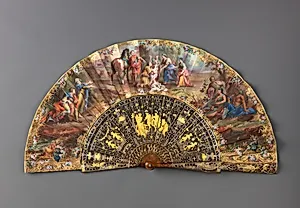
Folding fan with The Finding of Romulus and Remus
Unknown Artist
mid-18th century
Medium
Leaf: gouache and bronze paint on paper. Sticks and guards: tortoiseshell, carved and pierced, with gold-and silver-toned metal leaf, mother-of-pearl veneer, and paper underlay (upper guards only). Pivot: clear paste jewel.
Dimensions
Length: 26.7 cm. (guard sticks) Width: 51.4 cm. (open)
Classification
Fans
Culture
Italian
Department
Robert Lehman Collection
Museum
Metropolitan Museum of Art, New York, NY
Credit
Robert Lehman Collection, 1975
Accession Number
1975.1.1560
Rights
Public Domain
Tags
Art Historical Context
Step into the enchanting world of 18th Italian decorative arts with this exquisite folding fan from the Robert Collection at The Metropolitan Museum of Art.itled *The Finding of Romulus Remus*, it vividly depicts the ancient Roman myth where the twin infants—future founders of Rome—are discovered by a shepherd after being nurtured by a she-wolf. Surrounded by figures of men, women,, and horses, the scene captures a pivotal moment of destiny, a popular motif in European art that celebrated Rome's legendary origins during the mid-1700s. Crafted with masterful finesse, the fan's leaf features gouache and shimmering bronze paint on paper, bringing the mythological drama to life with rich colors and metallic highlights. Its tortoiseshell sticks and guards are intricately carved and pierced, embellished with gold- and silver-toned metal leaf, mother-of-pearl veneer, and a sparkling clear paste jewel at the pivot. Measuring 26.7 cm long when closed and spanning 51.4 cm open, this fan exemplifies the opulent materials and technical virtuosity prized in Italian workshops of the era. Beyond its beauty, the fan served as a fashionable accessory for Europe's elite, doubling as a portable canvas for storytelling and social display. It reflects the cultural fascination with classical antiquity during the Enlightenment, blending myth, craftsmanship, and elegance in a single, foldable treasure.