
Folding knife
Unknown Artist
1761–62
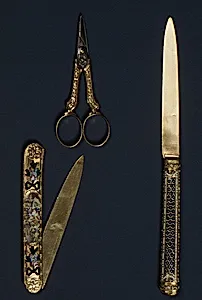
Medium
Gold, enamel
Dimensions
Length (closed): 4 1/8 in. (10.5cm)
Classification
Metalwork-Gold and Platinum
Culture
French, Paris
Department
European Sculpture and Decorative Arts
Museum
Metropolitan Museum of Art, New York, NY
Credit
Bequest of Catherine D. Wentworth, 1948
Accession Number
48.187.497
Rights
Public Domain
Art Historical Context
This exquisite folding knife, crafted in around 1761–62, exemplifies the pinnacle of French luxury metalwork during the lavish era of Louis XV. Measuring just 4 1/8 inches when closed, this diminutive yet opulent object was likely designed for the elite—perhaps as a gentleman's accessory or a lady's vanity item—blending practicality with unparalleled artistry. Housed in the Metropolitan Museum of Art's European Sculpture and Decorative department, it entered the collection through the 1948 bequest of D. Wentworth. Fashioned from gold and adorned with enamel, the knife showcases virtuoso techniques of the Parisian workshops. Goldsmiths of the time mastered champlevé or cloisonné enameling, where powdered glass is fused to gold in intricate patterns, creating vibrant, durable colors that resisted wear. This medium elevated everyday tools into jewels, reflecting the Rococo taste for playful elegance and fine detail prevalent in mid-18th-century France. As a cultural artifact, it highlights Paris's renown as Europe's center for decorative arts, where master craftsmen catered to aristocracy and royalty. Such knives symbolized status and sophistication, bridging utility and ornamentation in an age of Enlightenment refinement. Visitors, imagine slipping this treasure into a silk pocket—a sparkling testament to 18th-century ingenuity!