
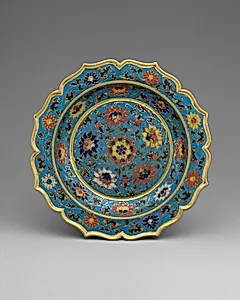
明早期 掐絲琺瑯纏枝蓮紋菱花口碟|Foliated dish with floral scrolls
Unknown Artist
early 15th century
Medium
Cloisonné enamel
Dimensions
H. 1 in. (2.5 cm); Diam. 6 in. (15.2 cm)
Classification
Cloisonné
Culture & Period
China · Ming dynasty (1368–1644)
Department
Asian Art
Museum
Metropolitan Museum of Art, New York, NY
Credit
Purchase, Florence and Herbert Irving Gift, 1993
Accession Number
1993.338
Rights
Public Domain
Tags
Art Historical Context
This exquisite cloisonné enamel dish, in early 15th-century Ming dynasty China, exemplifies the imperial workshops' mastery of a luxurious technique borrowed from Western Asia and refined during the Yongle era (1402–1424). just 6 inches in diameter with a delicately foliated rim, the dish features intricate floral scrolls of lotus motifs—symbols of purity and enlightenment in Chinese culture—rendered in vibrant blues, reds, and greens against a gleaming metal body. Cloisonné enamel, known as *jiaotai* in Chinese, involves soldering fine silver or gold wires into raised cells (*cloisons*) on a copper base, filling them with powdered glass enamels, firing repeatedly, and polishing to a luminous finish. This labor-intensive process, perfected under Ming patronage, produced durable yet opulent wares for the imperial court and elite collectors, blending metalwork with painterly precision. Housed in the Metropolitan Museum of Art's Asian Art Department (purchased with the Florence and Herbert Irving Gift in 1993), this dish highlights the Ming dynasty's cultural zenith, where such objects bridged artistry and ritual, evoking the splendor of palace banquets and scholarly appreciation. A testament to anonymous artisans' skill, it invites us to marvel at floral elegance frozen in enduring enamel.