
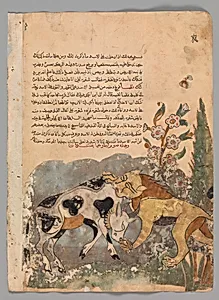
Folio from a Kalila wa Dimna
Unknown Artist
second quarter 16th century
Medium
Ink and opaque watercolor on paper
Dimensions
Overall: H. 12 1/2 in. (31.8 cm) W. 8 7/8 in. (22.6 cm) Average text size: H. 8 5/8 in. (21.9 cm) W. 4 7/8 in. (12.4 cm)
Classification
Codices
Department
Islamic Art
Museum
Metropolitan Museum of Art, New York, NY
Credit
The Alice and Nasli Heeramaneck Collection, Gift of Alice Heeramaneck, 1981
Accession Number
1981.373.42
Rights
Public Domain
Tags
Art Historical Context
This exquisite folio from a *Kalila wa Dimna*, dating to the second quarter of the 16 century, offers a glimpse into the rich tradition of Persian illuminated books. *Kalila wa Dimna a timeless collection of animal fables from ancient Indian tales into Arabic and Persian, uses stories of cunning lions, wise cows, and other beasts to impart moral lessons on friendship, deception, and governance. Likely depicting a scene with lions and cows—common protagonists in these narratives—this page blends text and illustration, inviting viewers to ponder its fable amid vibrant imagery. Crafted with ink and opaque watercolor on paper, the artwork exemplifies the meticulous techniques of Islamic miniature painting. Opaque watercolors create bold, jewel-like hues and intricate details, while precise ink outlines define figures and landscapes on a modest scale (12½ × 8⅞ inches). Such folios were prized in royal courts, where manuscripts served as both literature and visual art, showcasing the scribe-artist's skill in harmonizing calligraphy with dynamic compositions. Housed in the Metropolitan Museum of Art's Islamic Art Department as part of the Alice and Nasli Heeramaneck Collection, this codex page highlights the cultural crossroads of Persian storytelling. During the Safavid era, such works flourished, bridging entertainment and ethics for audiences from scholars to sultans, reminding us of the enduring wisdom in animal allegories.