
Folio from a Manuscript by Mir Ali Shir Nava'i
early 16th century
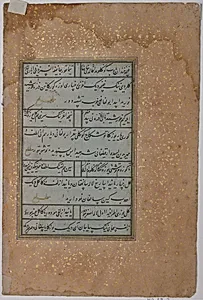
Medium
Ink, opaque watercolor, and gold on paper
Dimensions
H. 5 7/8 in. (14.9 cm) W. 4 in. (10.2 cm)
Classification
Codices
Department
Islamic Art
Museum
Metropolitan Museum of Art, New York, NY
Credit
Samuel D. Lee Fund, 1940
Accession Number
40.39.2
Rights
Public Domain
Art Historical Context
This delicate folio from a manuscript by Mir Ali Shir N'i, dating to the early 16 century, offers a window into the golden age of Timurid literary and artistic culture in Central Asia. Nava'i, a prolific, scholar, and patron of the arts, authored works in Chagatai Turkic that celebrated love, mysticism, and moral philosophy. As part of a codex—a bound manuscript book—this page exemplifies the Islamic tradition of blending profound text with visual splendor, likely featuring his elegant poetry rendered in masterful calligraphy. Crafted with ink, opaque watercolor, and gold on paper, the artwork measures just 5 7/8 by 4 inches, inviting intimate contemplation. Opaque watercolors provided vivid, jewel-like hues, while gold leaf added a luminous, almost ethereal glow, techniques perfected in Persianate workshops. These methods not only enhanced readability but elevated the manuscript to a sacred art form, where script and illumination harmonized to convey spiritual depth. Housed in the Metropolitan Museum of Art's Islamic Art Department (Samuel D. Lee Fund, 1940), this folio underscores the cultural crossroads of literature and illumination in the Islamic world, preserving Nava'i's legacy for modern admirers. Pause here to appreciate how such tiny treasures bridged poetry and painting across centuries.