
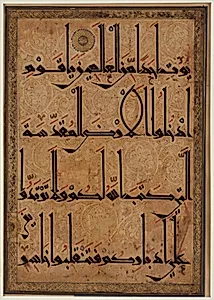
Folio from a Qur'an Manuscript
Unknown Artist
ca. 1180
Medium
Ink, opaque watercolor, and gold on paper
Dimensions
H. 11 3/4 in. (29.8 cm) W. 8 3/4 in. (22.2 cm)
Classification
Codices
Department
Islamic Art
Museum
Metropolitan Museum of Art, New York, NY
Credit
H. O. Havemeyer Collection, Gift of Horace Havemeyer, 1929
Accession Number
29.160.23
Rights
Public Domain
Tags
Art Historical Context
This exquisite folio from a Qur'an, dating to around 1180, offers a glimpse into the golden age of Islamic calligraphy and book arts. Produced during the medieval Islamic period, likely in a region like Persia or the Abbasid heartlands, it formed part of a larger codex—a bound volume of the sacred Qur'anic text. Such manuscripts were not mere books but objects of profound devotion, meticulously crafted to honor Allah's words with visual splendor. The artwork's medium—ink, opaque watercolor, and gold on paper—highlights innovative techniques of the era. Precise Kufic or early Naskh script renders the Arabic verses, while vibrant watercolors and burnished gold illuminate diacritical marks, chapter headings, and decorative motifs like arabesques. At 11¾ × 8¾ inches, its intimate scale invited personal contemplation, reflecting the Islamic emphasis on beauty in the divine. Housed in the Metropolitan Museum of Art's Islamic Art department as part of the H.O. Havemeyer Collection (gift of 1929), this folio underscores the cultural pinnacle of Qur'anic illumination. It reminds visitors of Islam's rich tradition of aniconism—favoring geometric and floral patterns over human forms—while preserving the eternal message of the Qur'an for generations.