
Folio from a Qur'an Manuscript
Unknown Artist
14th century
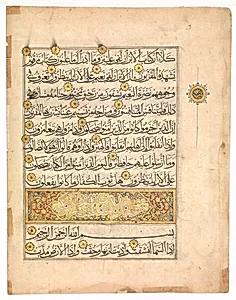
Medium
Ink, opaque watercolor, and gold on paper
Dimensions
H. 16 3/16 in. (41.1 cm) W. 12 5/8 in. (32.1 cm)
Classification
Codices
Department
Islamic Art
Museum
Metropolitan Museum of Art, New York, NY
Credit
Gift of Mr. and Mrs. Russell Pickering, 1969
Accession Number
69.149
Rights
Public Domain
Tags
Art Historical Context
This exquisite folio from a 14-century Qur'an manuscript exemplifies the pinnacle of Islamic calligraphy, a sacred art form revered across the Muslim world. Crafted an unknown master scribe, it features verses from the holy Qur'an rendered in flowing ink scripts, adorned with vibrant opaque watercolors and shimmering gold on fine paper. Measuring 16 3/16 by 12 5/8 inches, its generous size suggests it belonged to a substantial codex, the bound book format that revolutionized manuscript production in the medieval Islamic era. In the 14th century, amid flourishing centers like Baghdad, Cairo, and Persia, Qur'an manuscripts were not merely religious texts but profound artistic achievements. Calligraphy held supreme status in Islamic culture, where figurative imagery was often eschewed in favor of the written word as a divine manifestation. The use of gold leaf and vivid pigments created illuminated panels that guided the reader's eye, blending spirituality with opulent beauty—evident in the intricate diacritical marks and marginal decorations that ensured precise recitation. Today, this folio graces the Metropolitan Museum of Art's Islamic Art department, a generous gift from Mr. and Mrs. Russell Pickering in 1969. It invites visitors to appreciate the timeless devotion behind each stroke, a testament to how art and faith intertwined in medieval Islam.