
Folio from a Qur'an Manuscript
A.H. 531/ 1137 CE
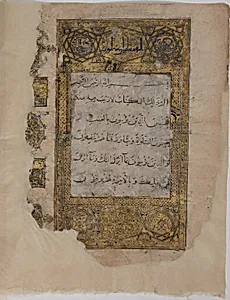
Medium
Ink, gold, and opaque watercolor on paper
Dimensions
H. 10 1/8 in. (25.7 cm) W. 7 1/2 in. (19 cm)
Classification
Codices
Department
Islamic Art
Museum
Metropolitan Museum of Art, New York, NY
Credit
Louis E. and Theresa S. Seley Purchase Fund for Islamic Art and Rogers Fund, 1996
Accession Number
1996.294.2
Rights
Public Domain
Tags
Art Historical Context
This exquisite folio from a Qur'an manuscript, crafted by the skilled calligrapher Muhammad al-Zanjani in 1137 CE (A.H. 531), offers a window into the golden age of Islamic manuscript production. During the 12th century, under dynasties like the Seljuks, Qur'ans were not just sacred texts but supreme artistic achievements, embodying devotion through intricate script. Al-Zanjani's work, measuring a compact 10 1/8 by 7 1/2 inches, exemplifies the precision and piety of this era's scribes, who transformed paper into vessels of divine word. Rendered in ink, gold, and opaque watercolor, the folio showcases Kufic or early Naskh script—hallmarks of Islamic calligraphy—where flowing letters interlace with geometric precision. Gold leaf illuminated verses, catching light to evoke spiritual radiance, while vibrant watercolors added subtle harmony without overpowering the text. This medium elevated Qur'ans from utilitarian books to treasures, often commissioned for mosques or scholars. Housed in the Metropolitan Museum of Art's Islamic Art Department, this piece (acquired through the Louis E. and Theresa S. Seley Purchase Fund and Rogers Fund in 1996) highlights the cultural centrality of the Qur'an in Islamic society. It reminds us how art and faith intertwined, preserving the holy text's beauty for generations.