
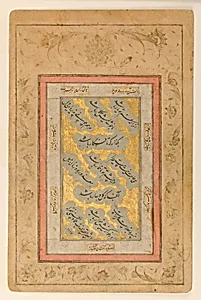
Folio with Verses in Nasta'liq Script
dated A.H. 1017/ 1608–9 CE
Medium
Ink, opaque watercolor, and gold on paper
Dimensions
H. 11 1/4 in. (28.6 cm) W. 7 1/2 in. (19.1 cm)
Classification
Codices
Department
Islamic Art
Museum
Metropolitan Museum of Art, New York, NY
Credit
Rogers Fund, 1946
Accession Number
46.126.3
Rights
Public Domain
Tags
Art Historical Context
This exquisite folio, created by the renowned Persian calligrap Mir `Imad al-Hasani in 1608–9 CE, showcases verses rendered in the elegant Nasta'liq script. the Safavid era in Iran—a golden age for Persian arts—calligraphy reigned supreme as the most revered visual art form in Islamic culture, often surpassing painting in prestige. Mir `Imad, one of the era's master scribes, was celebrated for his fluid, rhythmic lines that brought poetry to life, making this piece a prime example of his virtuosity. Crafted with ink, opaque watercolor, and gold on paper, the folio measures 11¼ × 7½ inches, typical of luxurious codices intended for elite patrons or royal libraries. Nasta'liq, developed in 14th-century Persia, is prized for its cursive grace and legibility, ideal for rendering Persian poetry like ghazals or divans. The gold accents and vibrant watercolors illuminate the text, enhancing its spiritual and aesthetic allure, while the precise proportions reflect disciplined training in the Islamic scribal tradition. Housed in the Metropolitan Museum of Art's Islamic Art Department (acquired via Rogers Fund, 1946), this work highlights calligraphy's role in preserving literature and faith. Visitors will appreciate how Mir `Imad's hand transformed words into a visual symphony, bridging devotion, beauty, and cultural heritage.