
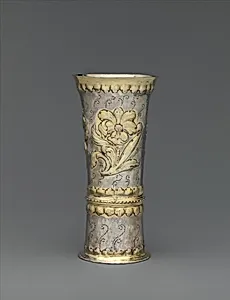
Footed beaker
mid-17th century
Medium
Silver, partly gilded
Dimensions
Overall: 5 15/16 x 2 13/16 in. (15.1 x 7.1 cm)
Classification
Metalwork-Silver
Culture
Hungarian, Brassó
Department
European Sculpture and Decorative Arts
Museum
Metropolitan Museum of Art, New York, NY
Credit
Gift of The Salgo Trust for Education, New York, in memory of Nicolas M. Salgo, 2010
Accession Number
2010.110.26
Rights
Public Domain
Tags
Art Historical Context
This elegant footed beaker, crafted by Hungarian silversmith Georgiusbell II in the mid17th century, exemplifies the refined metalwork traditions of Brassó (now Brașov, Romania), a vibrant Transylvanian center under Hungarian cultural influence. Standing just under 6 inches tall, its slender form—made of silver with partial gilding—evokes opulence of Baroque-era drinking vessels, likely used in ceremonial toasts or elite households. The gilding technique, where gold is applied selectively to highlight surfaces, not only enhances durability against tarnish but also creates a luxurious contrast, drawing the eye to intricate details like floral motifs. As a piece of European decorative arts, the beaker reflects the era's fusion of Eastern European craftsmanship with Renaissance-inspired elegance. Brassó's silversmiths, often of German descent, were renowned for such functional yet artistic objects, blending utility with symbolic decoration—flowers here suggesting abundance and festivity. Donated to the Metropolitan Museum of Art in 2010 by The Salgo Trust, it offers a tangible link to 17th-century Hungary's prosperous artisan guilds, inviting visitors to appreciate the tactile beauty of historical silverwork.