
Footed dish
Unknown Artist
first half 17th century
Medium
Tin-glazed earthenware
Dimensions
Overall: 2 3/4 × 9 1/4 in. (7 × 23.5 cm)
Classification
Ceramics-Pottery
Culture
probably French, Nevers
Department
European Sculpture and Decorative Arts
Museum
Metropolitan Museum of Art, New York, NY
Credit
Bequest of Mary Mandeville Johnston, from the collection of Mr. and Mrs. Edward W. S. Johnston, 1914
Accession Number
14.102.354
Rights
Public Domain
Tags
Art Historical Context
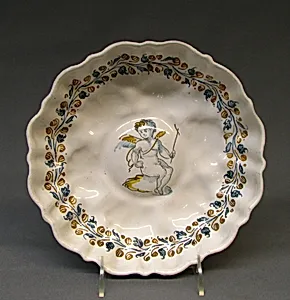
This charming footed dish, crafted in the first half of the 17th century, hails from the vibrant faience workshops of Nevers France—a hub of European ceramics production. Made of tin-glazed earthen, it exemplifies the technique where a tin oxide coating creates a smooth, white surface ideal for vivid painted decorations. Standing just 2¾ inches tall and 9¼ inches wide, this petite vessel was likely used for serving sweets or as a decorative centerpiece, blending functionality with artistry. Nevers faience makers drew inspiration from Italian maiolica, achieving brilliant blues, yellows, and greens through metallic oxide pigments fired at low temperatures. The dish's playful putti—chubby, winged cherubs—reflect Baroque-era motifs symbolizing joy and abundance, common in French decorative arts of the period. These lively figures evoke the opulent tastes of the early modern elite, who prized such wares as affordable luxuries mimicking costly porcelain. Now housed in the Metropolitan Museum of Art thanks to the 1914 bequest of Mary Mandeville Johnston, this anonymous masterpiece highlights Nevers' role in democratizing fine ceramics across Europe, bridging Renaissance elegance with emerging French style. A delightful glimpse into 17th-century domestic splendor!