
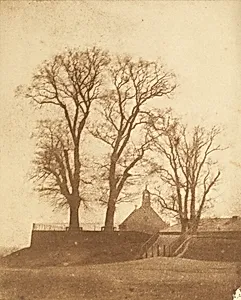
Forbury Hill, Reading
Medium
salted paper print
Dimensions
image: 10.1 x 8.2 cm (4 x 3 1/4 in.) sheet: 11.2 x 9.4 cm (4 7/16 x 3 11/16 in.)
Classification
Photograph
Department
CPH
Museum
National Gallery of Art, Washington, D.C.
Credit
Paul Mellon Fund
Accession Number
2007.29.21
Rights
Public Domain
Art Historical Context
Visitors to the National Gallery of Art's photography collection will delight in *Forbury Hill, Reading a salted paper print attributed to Nicola Henneman around 1845. Henneman, a Dutch-born photographer and close collaborator of pioneering inventor William Henry Fox Talbot, the gentle slopes and everyday charm of this English landscape in Reading, Berkshire. The modest image size—10.1 x 8.2 cm—invites intimate viewing, evoking the experimental spirit of photography's dawn. This work exemplifies the calotype process, Talbot's breakthrough negative-positive system introduced in the early 1840s. Henneman sensitized paper with salt and silver nitrate, exposed it to light via a paper negative, and fixed the delicate tones, producing subtle gradations of gray that convey atmospheric depth. Unlike the sharp daguerreotypes of the era, salted paper prints offered reproducibility and a painterly softness, marking a pivotal shift toward photography as an artistic medium. As one of the earliest surviving photographs from Henneman's hand, *Forbury Hill* highlights the medium's rapid evolution and its role in documenting the familiar world. Acquired through the Paul Mellon Fund, it reminds us how 19th-century innovators like Henneman transformed sunlight into history, bridging art and science in our galleries.