
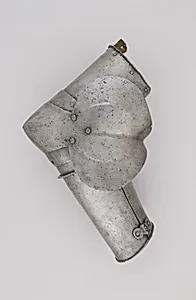
Forearm Defense (Vambrace)
Unknown Artist
ca. 1425–50, with later restorations
Medium
Steel, leather
Dimensions
H. 8 1/4 in. (21 cm); W. 3 1/2 in. (8.9 cm); D. 3 in. (7.6 cm)
Classification
Armor Parts
Culture
Italian
Department
Arms and Armor
Museum
Metropolitan Museum of Art, New York, NY
Credit
Bashford Dean Memorial Collection, Bequest of Bashford Dean, 1928
Accession Number
29.150.24
Rights
Public Domain
Art Historical Context
This elegant forearm defense, known as a vambrace, hails from Italy around 1425–50, a pivotal era when plate armor evolved to offer comprehensive protection for knights and soldiers. Crafted from steel with leather components, it measures a compact 8¼ inches high, designed to shield the vulnerable forearm during the chaos of medieval combat or tournaments. Its Italian origins reflect the Renaissance ingenuity of Milanese and other northern Italian workshops, renowned for producing high-quality, form-fitting armor that balanced mobility and defense. The vambrace's construction highlights masterful blacksmithing techniques: the steel was likely hammered and shaped over forms to hug the arm's contours, with leather straps for secure fastening. Later restorations preserved its functionality and form, underscoring its survival through centuries. As part of the Metropolitan Museum of Art's Arms and Armor collection—gifted via the Bashford Dean Memorial Collection—this piece offers a tangible link to the chivalric world, where such gear symbolized status and survival. Fun fact: Vambraces like this became standard by the mid-15th century, paving the way for the fully enclosed suits of armor that defined European warfare. A testament to human craftsmanship amid conflict!