
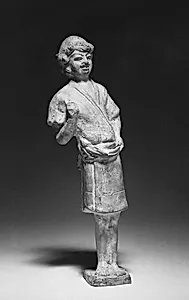
唐 陶胡人馬夫俑|Foreign horse groom
Unknown Artist
7th–8th century
Medium
Earthenware
Dimensions
H. 10 1/2 in. (26.7 cm)
Classification
Tomb Pottery
Culture & Period
China · Tang dynasty (618–907)
Department
Asian Art
Museum
Metropolitan Museum of Art, New York, NY
Credit
Gift of Mr. and Mrs. Ezekiel Schloss, 1985
Accession Number
1985.208.4
Rights
Public Domain
Tags
Art Historical Context
This charming earthenware figure, titled *Foreign Horse Groom* (唐 陶胡人馬夫俑), hails from China's Tang dynasty (618–), specifically the 7th–8th century—a golden era of cultural flourishing and international exchange along the Silk Road. Standing 10½ inches (26.7 cm) tall, this tomb pottery depicts a non-Han "Hu" man, likely a Central Asian tending imperial horses. Such mingqi figures were crafted to serve the deceased in the afterlife, reflecting Tang beliefs in continuity between worlds. The Tang court's cosmopolitan spirit shines through in this piece, as Hu figures became popular in art, symbolizing the dynasty's embrace of foreign traders, musicians, and horsemen from regions like Persia and Central Asia. Earthenware, low-fired clay often left unglazed, allowed for vivid modeling of facial features, flowing robes, and dynamic poses, capturing ethnic diversity with remarkable realism and whimsy. As a gift to the Metropolitan Museum of Art from Mr. and Mrs. Ezekiel Schloss in 1985, this unknown artist's work offers a window into Tang's vibrant multiculturalism, reminding us how ancient burials preserved snapshots of a connected world.