
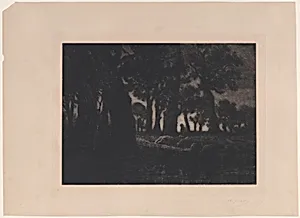
Forest Edge at Twilight
ca. 1866
Medium
Etching
Dimensions
Sheet: 18 1/2 × 25 3/8 in. (47 × 64.5 cm) Plate: 13 3/8 × 18 1/2 in. (34 × 47 cm)
Classification
Prints
Department
Drawings and Prints
Museum
Metropolitan Museum of Art, New York, NY
Credit
Gift of Mrs. Howard Mansfield, 1951
Accession Number
51.647.1
Rights
Public Domain
Art Historical Context
**Forest Edge at Twilight** Charles Jacque, created around 1866, invites visitors into the tranquil world of 19th-century rural France. Jacque, a prominent member of the Barbizon School alongside artists like Millet and Rousseau, specialized in pastoral scenes that celebrated the unadorned beauty of the countryside. This etching depicts a forest's edge bathed in the soft, fading light of dusk, evoking the movement's emphasis on direct observation of nature and a rejection of Romantic idealization in favor of realistic, atmospheric landscapes. As an etching, the work showcases Jacque's mastery of intaglio printmaking, where acid bites into a metal plate to create intricate lines that capture subtle textures—from the dense foliage to the misty horizon. Etchings were revolutionary in the 19th century, allowing artists to produce detailed, reproducible images that brought fine art to broader audiences beyond oil. The plate measures 13 3/8 × 18 1/2 inches, with the full sheet slightly larger at 18 1/2 × 25 3/8 inches, highlighting the medium's capacity for expansive compositions. Generously gifted to the Metropolitan Museum of Art by Mrs. Howard Mansfield in 1951, this print from the Drawings and Prints department remains a testament to Jacque's skill in conveying twilight's quiet magic. Pause here to imagine the hush of evening in the forest—perfect for reflection on nature's enduring allure.
About the Artist
Charles Jacque · 1813–1894
Charles-Émile Jacque (1813–1894) was a pioneering French painter, engraver, and illustrator whose career bridged the worlds of printmaking and pastoral painting. Born in Paris amid a difficult childhood, he apprenticed at age seventeen to a map engraver, mastering drypoint technique and producing his first etching in 1830—a copy of a head after Rembrandt. After serving seven years in the French Ar...