
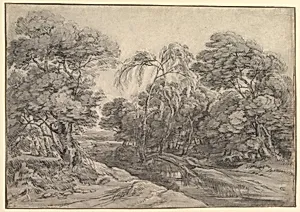
Forest Landscape
early 17th–mid 17th century
Medium
Black chalk, gray wash; framing line in pen and brown ink
Dimensions
sheet: 10 3/8 x 14 9/16 in. (26.3 x 37 cm)
Classification
Drawings
Department
Drawings and Prints
Museum
Metropolitan Museum of Art, New York, NY
Credit
Frits and Rita Markus Fund, 2012
Accession Number
2012.41
Rights
Public Domain
Tags
Art Historical Context
Lodewijk de Vadd *Forest Landscape*, created in the early to mid-17th century, captures the dense, atmospheric beauty of nature in a delicate drawing on paper. Measuring 10 3/8 x 14 9/16 inches, this work exemplifies the Flemish artist's mastery of landscape depiction during the Baroque era. De Vadder, active in Brussels, drew inspiration from the rich woodland traditions of earlier masters like Jan Brueghel the, rendering forests as immersive, almost mystical realms teeming with intricate foliage and subtle depth. Rendered in black chalk and gray wash, with a framing line in pen and brown ink, the piece showcases virtuoso techniques for tonal modeling and texture. The chalk provides soft, velvety shading to evoke dappled light filtering through trees, while the wash adds misty atmosphere—a hallmark of 17th-century draftsmanship that bridged painting and printmaking. Such drawings were prized by collectors for their immediacy and as studies for larger oils, reflecting the growing fascination with nature's grandeur amid Europe's artistic Golden Age. Today, this evocative sheet resides in the Metropolitan Museum of Art's Drawings and Prints department, acquired through the Frits and Rita Markus Fund in 2012. It invites visitors to ponder the timeless allure of untamed forests, a theme that resonated in an age of exploration and scientific curiosity about the natural world.
About the Artist
Lodewijk de Vadder · 1605–1655
Comment on works: Landscapes