
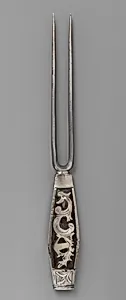
Fork
Unknown Artist
18th century
Medium
Steel, silver, leather or wood
Dimensions
Length (fork .25): 8 1/4 in. (21 cm)
Classification
Metalwork-Steel
Culture
Southern German
Department
European Sculpture and Decorative Arts
Museum
Metropolitan Museum of Art, New York, NY
Credit
Gift of R. Stuyvesant, 1891
Accession Number
91.16.25
Rights
Public Domain
Art Historical Context
This elegant 18th-century fork Southern Germany exemplifies the exquisite metalwork traditions of the region, where skilled artisans crafted functional objects into works of art. Made primarily of steel with silver accents and a handle possibly wrapped in leather or wood, measures a compact 8¼ inches (21 cm) in length—ideal for table use or perhaps as part of a traveler's set. Housed in the Metropolitan Museum of Art's Department of European Sculpture and Decor Arts, it was generously gifted by R. Stuyvesant in 1891, highlighting its enduring appeal to collectors. In the 18th century, Southern German craftsmen, particularly from areas like Bavaria, were renowned for their mastery of steel etching and embellishment techniques, blending utility with ornamental flair. Forks, once a novelty in Northern Europe, had by this era become symbols of refined dining culture, evolving from Italian origins into versatile implements for everyday elegance. This piece reflects that shift, showcasing the period's attention to durable materials and subtle luxury. Though the artist remains unknown, the fork's survival speaks to the high quality of Southern German metalwork, offering visitors a tangible glimpse into 18th-century domestic life and craftsmanship. A delightful reminder of how even utensils could embody artistry!