
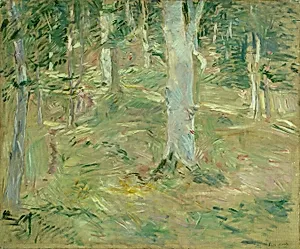
Forêt de Compiègne
1885
Medium
Oil on canvas
Dimensions
54.2 × 64.8 cm (21 3/8 × 25 1/2 in.)
Classification
oil on canvas
Department
Painting and Sculpture of Europe
Museum
Art Institute of Chicago
Accession Number
53058
Rights
Public Domain
Art Historical Context
Step into the sun-dappled tranquility of Berthe Morisot's *Forêt de Compiègne* (1885), an enchanting oil on canvas that captures lush beauty of the Compiègne Forest, a historic woodland north of Paris once favored by French royalty for hunting. Measuring 54.2 × 64.8 cm, this intimate landscape exemplifies Morisot's mastery as a leading Impressionist, a movement she helped pioneer alongside peers like Monet and Renoir. Painted en plein air during the movement's mature phase, it reflects the late 19th-century fascination with everyday nature, away from the urban bustle of Paris. Morisot's signature loose, feathery brushstrokes and vibrant color palette evoke the fleeting play of sunlight filtering through leaves, dissolving forms into shimmering impressions rather than precise details—a hallmark of Impressionism's revolutionary break from academic realism. As one of the few women in the avant-garde circle, her fresh, lyrical vision brought a uniquely intimate sensitivity to the genre, often infusing landscapes with a sense of immediacy and emotional lightness. Housed in the Art Institute of Chicago's Department of Painting and Sculpture of Europe, this work highlights Morisot's enduring legacy: bridging domestic intimacy and natural splendor. Visitors are drawn to its glowing vitality, a testament to how Impressionism transformed canvas into a window on ephemeral beauty.
About the Artist
Berthe Morisot · 1841–1895
Berthe Morisot (1841-1895) was a founding member of the Impressionist movement and one of the most significant women artists of the 19th century. Born into an affluent bourgeois family in Bourges, France—her mother was a great-niece of the Rococo painter Jean-Honoré Fragonard—Morisot received serious artistic training despite the social constraints facing women of her class. Under the guidance of...