
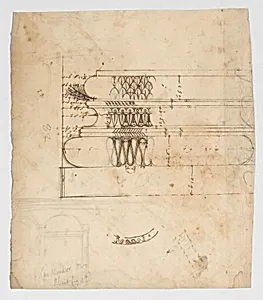
Forum of Augustus, hemicycle, Attic base, elevation and sculpted detail; Ionic capital, elevation; Palazzo Baldassini, cortile, elevation (recto) blank (verso)
early to mid-16th century
Medium
Dark brown ink, black chalk, and incised lines
Dimensions
sheet: 10 7/16 x 9 1/16 in. (26.5 x 23 cm)
Classification
Drawings|Ornament & Architecture
Department
Drawings and Prints
Museum
Metropolitan Museum of Art, New York, NY
Credit
Purchase, Rogers Fund, Joseph Pulitzer Bequest, and Mark J. Millard Gift, 1968
Accession Number
68.769.41
Rights
Public Domain
Tags
Art Historical Context
This exquisite 16th-century French drawing captures the meticulous eye of an anonymous architect or draughtsman studying classical antiquity. On the recto, it presents precise elevations and sculpted details from Rome's ancient Forum of Augustus—specifically a hemicycle's Attic base and an Ionic capital—alongside the elegant cortile (courtyard) of Palazzo Baldass, a Renaissance palace. Rendered in dark brown ink, black, and incised lines a modest 10 7/16 x 9 1/16-inch sheet, the verso remains blank, suggesting it was a working sketch for further use. Created in the early to mid-16th century, this piece reflects the Renaissance fervor for rediscovering Roman architecture. French artists and architects, often traveling to Italy, documented ancient ruins like the Forum of Augustus (built by Emperor Augustus around 2 BCE) to revive classical orders and proportions. The Palazzo Baldassini detail nods to contemporary Roman palazzo design, blending antiquity with emerging High Renaissance style. Incised lines indicate practical techniques for tracing or transferring motifs, vital for builders replicating these forms across Europe. Housed in the Metropolitan Museum of Art's Drawings and Prints department, this anonymous gem highlights how such studies fueled the architectural revolution, influencing everything from French châteaux to grand public forums. A testament to the era's scholarly passion, it invites us to trace the enduring legacy of Rome's splendor.