
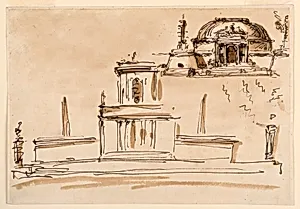
Fountain and a mausoleum
Classification
architecture
Department
Smithsonian Collection
Museum
Smithsonian American Art Museum
Credit
Museum purchase through gift of various donors and from Eleanor G. Hewitt Fund
Accession Number
1938-88-1176
Rights
Public Domain
About this artwork
Research in Progress
Art Historical Context
Giuseppe Barberi (1746–1809), a prominent Italian architect of the late 18th, created *Fountain and a Maus* around 1790. This architectural work captures the elegance of Neoclassical design, a style Barberi championed in Rome, blending ancient Roman grandeur with refined proportions. Classified as architecture within the Smithsonian American Art Museum collection, it likely represents a conceptual drawing or etching envisioning a fountain paired with a mausoleum—elements often found in grand Italian gardens, villas, or commemorative landscapes of the era. The piece reflects the Enlightenment-era fascination with antiquity and memorial architecture, where fountains symbolized vitality and mausoleums honored the eternal. Acquired through museum purchase with gifts from various donors and the Eleanor G. Hewitt Fund, it highlights cross-cultural exchanges in American collections. With research ongoing, *Fountain and a Mausoleum* invites visitors to ponder Barberi's vision of harmonious, monumental spaces that blend water's life force with solemn remembrance. (178 words)