
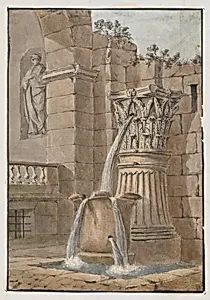
Fountain in a Courtyard
in or before 1768
Medium
pen and gray ink and watercolor over graphite on laid paper; graphite and brown ink sketches on verso
Dimensions
sheet: 24.5 x 17.1 cm (9 5/8 x 6 3/4 in.) page size: 42.5 x 27.7 cm (16 3/4 x 10 7/8 in.)
Classification
Drawing
Department
CG-E
Museum
National Gallery of Art, Washington, D.C.
Credit
Mark J. Millard Architectural Collection
Accession Number
1983.49.150
Rights
Public Domain
Art Historical Context
**Fountain in a Courtyard** *Charles Louis Clérisse, in or before 1768* Step into the sun-dappled elegance of Charles Louis Clérisseau *Fountain in a Cour*, a delicate architectural drawing that captures the refined beauty of 18th-century neoclassicism. Created in or before 1768, work reflects Clérisseau's fascination with classical antiquity, honed during his travels through Italy. As a pioneering French architect and draughtsman, he meticulously recorded ancient Roman motifs, influencing later figures like Thomas Jefferson. Here, the serene courtyard fountain evokes the harmonious proportions and tranquil spaces of Renaissance and Roman gardens, blending fantasy with precise observation. Rendered in pen and gray ink with watercolor over graphite on laid paper—a favored medium for its absorbency and texture—this sheet (24.5 x 17.1 cm) showcases Clérisseau's masterful technique. Subtle graphite underdrawings provide structure, while fluid ink lines and soft washes add depth and atmosphere, turning a study into a poetic vision. The verso's graphite and brown ink sketches reveal his iterative process, a hallmark of Enlightenment-era architectural practice. Housed in the National Gallery of Art's Mark J. Millard Architectural Collection (Department CG-E), this drawing highlights Clérisseau's role in bridging European classicism with emerging American tastes, offering visitors a window into the intellectual currents that shaped modern architecture.