
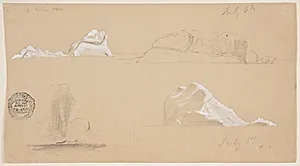
Four Floating Icebergs, Canada
July 4 and 5, 1859
Classification
seascapes
Department
Smithsonian Collection
Museum
Smithsonian American Art Museum
Credit
Gift of Louis P. Church
Accession Number
1917-4-273-c
Rights
Public Domain
About this artwork
Research in Progress
Art Historical Context
Frederic Edwin Church, leading figure of the Hudson River School, the raw majesty of nature in *Four Floating Icebergs,*, sketched on July 4 and 5, 1859. This seascape emerged from Church's daring expedition to Newfoundland and Labrador that summer, where he ventured aboard a sealing ship to study colossal icebergs firsthand. Amid the perilous Arctic waters, he filled sketchbooks with precise on-site drawings, blending scientific observation with romantic awe—a hallmark of 19th-century American landscape art. Church's Hudson River School style emphasized the sublime power of the natural world, portraying icebergs not just as frozen masses but as towering cathedrals of ice that evoked both beauty and danger. These rapid field studies, rendered with luminous detail, likely served as studies for his grander canvas *Icebergs* (1861), which mesmerized audiences and symbolized America's manifest destiny amid a changing climate. Donated by his son Louis P. Church, the work now graces the Smithsonian American Art Museum, offering a window into an era when artists risked life to document vanishing wilderness. Though the medium remains under research, its classification as a seascape underscores Church's pioneering role in elevating American scenery to epic proportions, inspiring generations to ponder humanity's place in nature's vast theater.