
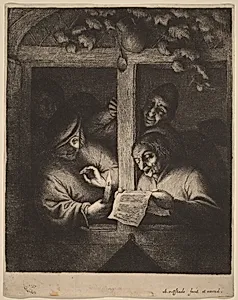
Four Men at a Window, One Reading from a Sheet by Candlelight
c. 1653
Medium
etching, with touches of drypoint, on laid paper
Dimensions
sheet (trimmed to plate mark): 23.8 x 18.9 cm (9 3/8 x 7 7/16 in.)
Classification
Department
CG-E
Museum
National Gallery of Art, Washington, D.C.
Credit
Rosenwald Collection
Accession Number
1943.3.8298
Rights
Public Domain
Art Historical Context
Adriaen van Ostade's *Four Men at a Window, One Reading from a Sheet Candlelight* (c. 1653) captures a tender moment of camaraderie in the Dutch Golden Age a period when everyday life became high art. Van Ostade, a master of genre scenes, specialized in depicting the humble joys and quirks of peasant life with warmth and wit. Influenced by Rembrandt, his works often highlight rural folk in intimate, dimly lit interiors, reflecting the era's growing fascination with realism and the common man amid Holland's prosperity. This etching, enriched with subtle drypoint touches, showcases van Ostade's technical prowess on laid paper. Etching allowed precise, fluid lines etched into a metal plate with acid, while drypoint's direct engraving added velvety burrs for dramatic texture and depth—perfect for evoking the flickering candlelight that bathes the scene in soft shadows. At 23.8 x 18.9 cm, its intimate scale draws viewers close, mirroring the huddled figures peering out a window, one reading aloud from a sheet, perhaps sharing news or a tale in a pre-electric world. Housed in the National Gallery of Art's Rosenwald Collection (CG-E, Prints), this work exemplifies how prints democratized art, making van Ostade's vivid vignettes accessible beyond oil paintings. It invites us to ponder literacy's quiet magic in 17th-century homes, blending historical insight with timeless human connection.
About the Artist
Adriaen van Ostade · 1610–1685
Adriaen Jansz. van Ostade (1610-1685) was a Dutch Baroque painter and printmaker who specialized in genre scenes of peasant life. Born and raised in Haarlem, he became one of the most prolific and celebrated artists of the Dutch Golden Age, producing over 800 paintings, 50 etchings, and numerous drawings. Van Ostade's significance in art history lies in his masterful depiction of peasant life, a ...