
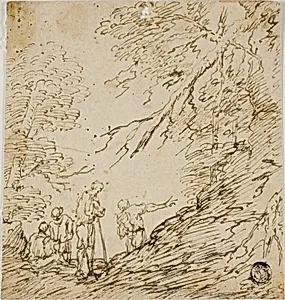
Four Men in Forest
n.d.
Medium
Pen and brown ink on tan laid paper
Dimensions
13.5 × 12.9 cm (5 3/8 × 5 1/8 in.)
Classification
pen and ink drawings
Department
Prints and Drawings
Museum
Art Institute of Chicago
Accession Number
82448
Rights
Public Domain
Art Historical Context
In the Prints and Drawings department of the Art Institute of Chicago sits a captivating small-scale drawing, *Four Men in Forest*, by the 17th-century Italian artist Salvator Rosa. Created with pen and brown ink on tan laid paper, this undated work measures just 13.5 × 12.9 cm, inviting close inspection of its intricate lines. Rosa, a key figure in the Baroque era, was renowned for his dramatic landscapes and rugged scenes that blended natural wilderness with human presence, often evoking a sense of mystery and untamed energy. The medium of pen and brown ink was ideal for Rosa's expressive style, allowing swift, gestural strokes to capture texture and depth through hatching and cross-hatching. Laid paper, with its characteristic chain lines, was a standard support for such preparatory sketches or independent studies in the 1600s, reflecting the artist's Neapolitan roots and his travels through Italy. This technique highlights Rosa's mastery in conveying movement and shadow, hallmarks of his proto-Romantic approach that influenced later landscape artists. Though modest in size, *Four Men in Forest* exemplifies Rosa's fascination with forested settings peopled by enigmatic figures, offering visitors a window into Baroque draftsmanship's vitality. It's a testament to how drawings like this preserved the raw creativity of a multifaceted genius—painter, poet, and satirist—bridging the gap between studio and nature.
About the Artist
Salvator Rosa · 1615–1673
Salvator Rosa was born in 1615 in Arenella, on the outskirts of Naples, into a world of artistic ambition and turbulent talent. His early training came through his maternal uncle, the painter Paolo Greco, and his brother-in-law Francesco Fracanzano, himself a pupil of the great Spanish-born Neapolitan master Jusepe de Ribera. Rosa showed a fierce independence from the start, resisting his father's...