
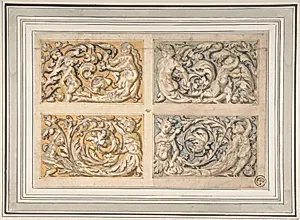
Four Panels with Rinceau Motif
17th century
Medium
Pen and brown ink, blue and gold watercolor, white lead highlighting (now oxidized)
Dimensions
sheet: 10 5/16 x 6 7/8 in. (26.2 x 17.5 cm)
Classification
Drawings
Department
Drawings and Prints
Museum
Metropolitan Museum of Art, New York, NY
Credit
The Elisha Whittelsey Collection, The Elisha Whittelsey Fund, 1966
Accession Number
66.551.14
Rights
Public Domain
Tags
Art Historical Context
Welcome to the Metropolitan Museum of Art's Drawings and Prints department, where you'll find *Four Panels with Rinceau Motif*, a delicate 17th-century Italian drawing by an anonymous artist. Created during the Baroque era, this work features four intricately designed panels adorned with scrolling rinceau—a classic ornamental motif of intertwined leaves and tendrils, playfully integrated with small human figures. Measuring just 10 5/16 x 6 7/8 inches, it likely served as a preparatory design for decorative panels in architecture, furniture, or frames, reflecting Italy's rich tradition of opulent ornamentation. The artist employed pen and brown ink for precise, flowing outlines that capture the lively rhythm of the foliage and figures, enhanced by blue and gold watercolor for a luxurious, jewel-like effect. White lead highlighting, intended to mimic shimmering metal or enamel, has oxidized over time into a darkened patina—a common fate for such materials, adding to the piece's aged charm. This technique showcases the virtuoso draftsmanship of the period, blending natural forms with whimsical humanity in a style reminiscent of Baroque exuberance. As part of The Elisha Whittelsey Collection, this anonymous gem highlights the unsung role of ornamental drawings in shaping Europe's visual culture, bridging fine art and craft. It's a window into 17th-century Italy's love for elaborate decoration, inviting you to trace the elegant vines and lively figures with your eye.