
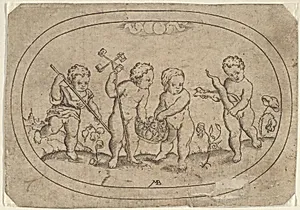
Four Putti, from Das Bossenbüchlein
ca. 1582
Medium
Engraving
Dimensions
Sheet: 2 3/8 × 3 3/8 in. (6.1 × 8.6 cm)
Classification
Prints|Ornament & Architecture
Department
Drawings and Prints
Museum
Metropolitan Museum of Art, New York, NY
Credit
The Elisha Whittelsey Collection, The Elisha Whittelsey Fund, 1955
Accession Number
55.503.18(10)
Rights
Public Domain
Tags
Art Historical Context
This delicate engraving, *Four Putti, from Das Bossenbüchlein*, captures four cheerful cherubs at work in a garden, each engaged in planting, watering, or tending to foliage. Created around 1582 by Mathias Beitler and Stephan Herman, the small print measures just over three inches wide, making it an intimate example of ornamental design from the late Renaissance. The figures embody the era’s revival of classical motifs, where playful putti—winged infants drawn from ancient Roman art—were reimagined as helpful garden spirits. Engraving allowed such designs to be widely shared, serving as pattern books for craftsmen, architects, and gardeners across Europe. *Das Bossenbüchlein* (“Little Book of Ornament”) likely offered decorative ideas for garden architecture and interior details, blending utility with delight. The Met’s impression, acquired through the Elisha Whittelsey Fund, preserves the fine lines and lively poses that made these prints both practical references and charming works of art in their own right.