
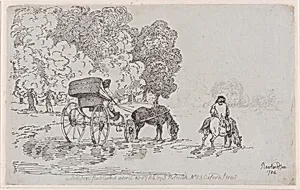
Four Wheel Chaise
April 10, 1785
Medium
Etching with stipple
Dimensions
Sheet: 4 15/16 in. × 8 in. (12.6 × 20.3 cm)
Classification
Prints
Department
Drawings and Prints
Museum
Metropolitan Museum of Art, New York, NY
Credit
The Elisha Whittelsey Collection, The Elisha Whittelsey Fund, 1959
Accession Number
59.533.86
Rights
Public Domain
Tags
Art Historical Context
Step into the lively world of 18th British satire with *Four Wheel Chaise*, charming 1785 etching with stipple by Thomas Rowland and John Raphael Smith.son, a master caricaturist famed for his humorous depictions of everyday life, collaborated with the skilled engraver Smith to capture this scene of a sleek four-wheel chaise—a lightweight, elegant carriage popular among the Georgian elite for leisurely travel and social display. Dated precisely to April 10, 1785, the print measures a compact 4 15/16 × 8 inches, perfect for collectors' albums. The artwork showcases prancing horses pulling the open carriage, evoking the era's fascination with mobility and status symbols amid Britain's expanding road networks and coaching culture. Etching provided crisp lines for outlines and details, while stippling—tiny dots building subtle tones—lent a soft, painterly glow, mimicking watercolor effects Rowlandson adored. This technique highlighted the sheen of horseflesh and the curve of wooden wheels, blending technical precision with whimsical energy. Housed in the Metropolitan Museum of Art's Elisha Whittelsey Collection, *Four Wheel Chaise* offers a window into pre-industrial transport and Rowlandson's satirical lens on society. It's a delightful nod to how art immortalized the clip-clop rhythm of Regency life.
About the Artist
Thomas Rowlandson|John Raphael Smith · 1756–1827
Thomas Rowlandson (1757–1827) was an English artist and caricaturist whose satirical watercolors and prints captured the social life of Georgian Britain with unparalleled wit and technical mastery. Alongside James Gillray, he is recognized as one of the greatest British graphic artists, and his distinctive flowing line and keen observations have made his work integral to understanding late 18th an...