
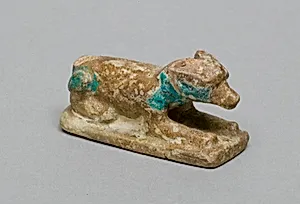
Fox
Unknown Artist
ca. 1850–1700 B.C.
Medium
Faience, traces of blue glaze
Dimensions
L. 6.7 cm (2 5/8 in)
Classification
Figurine, Fox
Period
Middle Kingdom
Department
Egyptian Art
Museum
Metropolitan Museum of Art, New York, NY
Credit
Rogers Fund, 1908
Accession Number
08.200.36
Rights
Public Domain
Tags
Art Historical Context
This charming faience fox, measuring just 6.7 centimeters in length, dates to Egypt’s Middle Kingdom, specifically the late Twelfth to Thirteenth Dynasty around 1850–1700 B.C. Created during a period of renewed stability and artistic refinement, such small animal figures were popular in elite and temple contexts. The unknown artist modeled the creature with alert ears and a slender body, capturing the essence of a desert fox in miniature form. Crafted from faience—a composite of crushed quartz with a glassy surface—the piece once bore traces of blue glaze, a color prized in ancient Egypt for evoking the Nile’s life-giving waters and the protective qualities of turquoise and lapis lazuli. Faience allowed artisans to produce durable, vividly colored objects that were more affordable than precious stones, making it ideal for amulets, votive offerings, or decorative accents placed in tombs or shrines. Though its exact original purpose remains unknown, this fox likely served both as a symbol of the natural world and a protective charm. Its survival through millennia highlights the technical skill of Middle Kingdom craftsmen and the enduring appeal of animal imagery in Egyptian culture.