
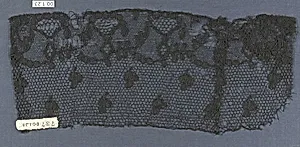
Fragment
Unknown Artist
19th century
Medium
Silk, bobbin lace
Dimensions
L. 12 x W. 4 inches (30.5 x 10.2 cm)
Classification
Textiles-Laces
Culture
French, Chantilly
Department
European Sculpture and Decorative Arts
Museum
Metropolitan Museum of Art, New York, NY
Credit
Gift of Georgiana Schuyler, 1900
Accession Number
00.1.23
Rights
Public Domain
Art Historical Context
This delicate silk bobbin lace fragment, from 19th-century Chantilly, France, exemplifies exquisite craftsmanship of one of Europe's most renowned lace-making traditions. Measuring just 12 by 4 inches, this narrow strip showcases the intricate, floral motifs typical of Chantilly lace—fine threads twisted and plaited by hand using bobbins to create a lightweight, sheer fabric with a scalloped edge. Bobbin lace, a labor-intensive technique dating back centuries, allowed artisans to produce complex patterns without needles, highlighting the skill of anonymous makers in workshops around the town of Chantilly, north of Paris. In the 19th century, Chantilly lace surged in popularity for high fashion, adorning gowns, veils, and trims for the elite during the Romantic and Victorian eras. Often dyed black for dramatic evening wear or left natural for daytime elegance, it symbolized luxury and femininity amid France's booming textile industry. Though this is a modest fragment—likely salvaged from a larger garment or furnishing—it preserves the artistry of a fading handicraft, as machine-made laces began to dominate by the late 1800s. Generously gifted to The Metropolitan Museum of Art in 1900 by Georgiana Schuyler, this piece now resides in the European Sculpture and Decorative Arts collection, offering visitors a tangible link to the refined world of 19th-century French decorative arts. Up close, its gossamer threads whisper of patience and precision.