
Fragment
Unknown Artist
ca. 1775
Medium
Bobbin lace
Dimensions
L. 24 x W. 3 inches (61.0 x 7.6 cm)
Classification
Textiles-Laces
Culture
French
Department
European Sculpture and Decorative Arts
Museum
Metropolitan Museum of Art, New York, NY
Credit
Gift of Mrs. W. Bayard Cutting, 1906
Accession Number
06.700
Rights
Public Domain
Tags
Art Historical Context
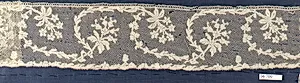
This delicate fragment of bobbin lace, created in France around 1775, exemplifies the craftsmanship of late 18th-century European arts. Measuring 24 by 3 inches, this narrow strip likely served as an edging or insertion for garments, linens or furnishings, featuring motifs inspired by leaves that evoke the natural elegance of the Rococo style's lingering influence. Donated to the Metropolitan Museum of Art in 1906 by Mrs. W. Bayard Cutting, it now resides in the European Sculpture andative Arts department, classified among textiles-laces. Bobbin lace, distinct from needle lace, is crafted by intertwining multiple threads held on handheld bobbins over a patterned pillow, allowing for precise, reversible patterns with a firm, structured texture. French lacemakers in this era were renowned for their technical virtuosity, producing pieces that rivaled fine jewelry in intricacy and value. During the Ancien Régime, such laces adorned the elite, symbolizing wealth and refined taste amid the opulence of Versailles. Though attributed to an unknown artist, this fragment highlights the anonymous mastery of guild-trained artisans, whose skills preserved France's leadership in luxury textiles. A testament to enduring beauty, it invites visitors to appreciate the labor-intensive artistry behind everyday luxury.