
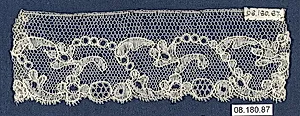
Fragment
Unknown Artist
19th century
Medium
Bobbin lace
Dimensions
L. 6 1/2 x W. 2 1/8 inches (16.5 x 5.4 cm)
Classification
Textiles-Laces
Culture
British, Chinnor, Oxfordshire
Department
European Sculpture and Decorative Arts
Museum
Metropolitan Museum of Art, New York, NY
Credit
The Nuttall Collection, Gift of Mrs. Magdalena Nuttall, 1908
Accession Number
08.180.87
Rights
Public Domain
Art Historical Context
This delicate *Fragment* of bobbin lace, crafted in 19th-century Britain from the village of Chor in Oxfordshire, offers a glimpse into the intricate world of traditional English textile arts. Measuring just 6½ by 2⅛ inches, this small piece exemplifies the precision of rural lace-making, likely intended as a trim for garments, linens, or furnishings. Produced anonymously by local artisans, it reflects the cottage industry that thrived in Oxfordshire, where skilled women wove fine threads into elaborate patterns using simple tools. Bobbin lace, the medium here, is a time-honored technique involving dozens of bobbins—small spools of thread pinned to a pillow or cushion. Artisans twist, cross, and plait the threads to create openwork designs, often floral or geometric motifs that mimic needle lace's complexity but with a distinctive, textured depth. In the 19th century, such laces were prized for their handmade quality amid growing industrialization, symbolizing both domestic artistry and regional pride. Housed in the Metropolitan Museum of Art's Department of European Sculpture and Decorative Arts as part of The Nuttall Collection (gifted in 1908), this fragment highlights the cultural heritage of British textiles. Though incomplete, it invites us to appreciate the patience and skill behind everyday elegance in Victorian-era life.