
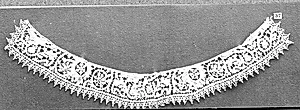
Fragment
Unknown Artist
17th century
Medium
Needle lace
Dimensions
L. 52 x W. 3 1/2 inches (132.1 x 8.9 cm)
Classification
Textiles-Laces
Culture
Italian
Department
European Sculpture and Decorative Arts
Museum
Metropolitan Museum of Art, New York, NY
Credit
Henrietta Seligman Lace Collection, Bequest of Mrs. Jesse Seligman, 1910
Accession Number
10.102.9
Rights
Public Domain
Art Historical Context
This exquisite *Fragment* of needle lace, crafted by an unknown Italian artist in the 17th, showcases the pinnacle of-era textile artistry. Measuring an impressive 52 inches long by 3½ inches wide, this slender strip exemplifies the delicate borders or flounces that adorned elite wardrobes, ecclesiastical vestments, and furnishings across Europe. Housed in the Metropolitan Museum of Art's European and Decorative Arts department it entered the collection through the generous bequest of Henrietta Selig in 1910, part of her renowned lace trove. Needle lace, or *punto in aria* ("point in air"), was a revolutionary Italian technique where artisans stitched fine linen threads freehand over a temporary paper pattern, using only a needle—no bobbins or looms required. This method allowed for unprecedented intricacy: swirling floral motifs, geometric lattices, and airy picots that mimicked the era's opulent Baroque designs. Emerging in Venice during the 16th century, it reached its zenith in the 17th, symbolizing wealth and piety amid Italy's textile boom fueled by trade and patronage. As a surviving fragment, it whispers of lace's cultural cachet—prized by nobility like Marie de' Medici and demanded by courts from Madrid to Versailles. Though incomplete, its preservation highlights the fragility and virtuosity of these "white gold" masterpieces, inviting us to marvel at the unseen hands that wove threads into wearable poetry.