
Fragment
Unknown Artist
18th century
Medium
Needle lace
Dimensions
L. 64 x W. 2 3/4 inches 162.6 x 7.0 cm
Classification
Textiles-Laces
Culture
French
Department
European Sculpture and Decorative Arts
Museum
Metropolitan Museum of Art, New York, NY
Credit
Henrietta Seligman Lace Collection, Bequest of Mrs. Jesse Seligman, 1910
Accession Number
10.102.54
Rights
Public Domain
Art Historical Context
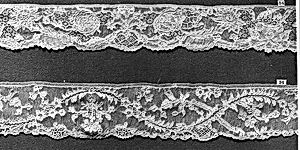
This exquisite *Fragment* of needle lace, crafted by an unknown French artist in the 18th century, the pinnacle of ornamental textile artistry from the Age of Enlightenment. Measuring an impressive 64 inches in length but only 2¾ inches wide, this slender strip likely served as a decorative border or flounce for elite garments, furnishings, or ecclesiastical vestments. Housed in the Metropolitan Museum of Art's European Sculpture and Decorative Arts, it entered the collection through the generous bequest of Henrietta Seligman in 1910, part of her renowned lace collection. Needle lace, or *point de France*, was a labor-intensive technique where artisans meticulously stitched fine linen threads with a needle to form intricate, free-form patterns—distinct from bobbin lace's woven structure. In 18th-century France, lace epitomized luxury and refinement, regulated by royal guilds and produced in prestigious centers like Alençon. This medium demanded extraordinary skill and time, transforming humble threads into delicate, sculptural forms that rivaled painting or sculpture in complexity. As a cultural artifact, this fragment reflects the opulence of Versailles-era fashion, where lace signaled wealth and taste among nobility. Though incomplete, its preservation highlights the fragility and enduring allure of these "white gold" masterpieces, inviting us to marvel at the anonymous hands that wove threads into wearable poetry. (198 words)