
Fragment
Unknown Artist
early 17th century
Medium
Silk
Dimensions
Overall: 11 1/2 x 11 1/2 in. (29.2 x 29.2 cm)
Classification
Textiles-Woven
Culture
Spanish
Department
European Sculpture and Decorative Arts
Museum
Metropolitan Museum of Art, New York, NY
Credit
Rogers Fund, 1919
Accession Number
19.163.7
Rights
Public Domain
Tags
Art Historical Context
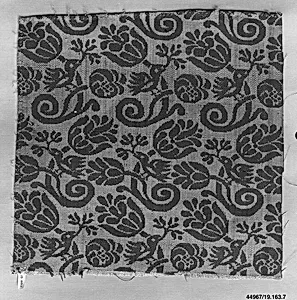
This exquisite silk fragment, woven in early 17th-century Spain, offers a glimpse into the opulent world of European decorative arts. Measuring a modest 11½ x 11½ inches, it showcases intricate motifs of birds amid blooming flowers, rendered with the finesse typical of Spanish textile mastery. Acquired through the Rogers Fund in 1919, it now resides in The Metropolitan Museum of Art's Department of European Sculpture and Decor Arts, classified as a woven textile. Crafted from luxurious silk—a material prized for its sheen and durability—this square fragment likely originated from a larger ecclesiastical vestment, wall hanging, or garment. Spanish weavers during this Baroque-era period drew from Renaissance traditions and global trade routes, importing silk via Seville to create vibrant, symbolic designs. Birds and flowers evoked themes of paradise, renewal, and divine beauty, common in textiles for churches or nobility. Though surviving as a fragment, it highlights Spain's pivotal role in textile innovation, blending technical precision with naturalistic elegance. Visitors can appreciate how such pieces illuminated grand interiors, bridging art and everyday splendor in the Golden Age of Spanish craftsmanship.