
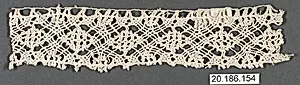
Fragment
Unknown Artist
16th century
Medium
Bobbin lace
Dimensions
L. 6 x W. 1 1/2 inches (15.2 x 3.8 cm)
Classification
Textiles-Laces
Culture
Italian, Venice
Department
European Sculpture and Decorative Arts
Museum
Metropolitan Museum of Art, New York, NY
Credit
Rogers Fund, 1920
Accession Number
20.186.154
Rights
Public Domain
Art Historical Context
This delicate *Fragment* of bobbin lace, crafted in 16th-century Venice, offers a glimpse into the Renaissance opulence of one of Europe's premier lace-making centers. Measuring just 6 by 1.5 inches, this tiny textile treasure exemplifies the exquisite craftsmanship that adorned the collars, cuffs, and veils of nobility. Acquired through the Rogers Fund in 1920, it resides in the Metropolitan Museum of Art's European Sculpture and Decorative Arts collection, highlighting Venice's pivotal role in the luxury trade. Bobbin lace, a technique perfected in Italy and Flanders during this era, involved twisting and intertwining fine linen threads over a patterned pillow using small bobbins—wooden or bone spools that allowed for complex, geometric designs. Unlike needle lace, which used a single thread and needle, bobbin lace created durable, openwork patterns through precise plaiting, making it ideal for wearable art. Venetian lacemakers, often women in convents or workshops, elevated this craft to high fashion, exporting it across Europe and influencing styles from Elizabethan England to the French court. Though anonymous, the artist's skill speaks volumes: each knot and loop reflects hours of meticulous labor, symbolizing Venice's blend of artistry and commerce. Visitors can marvel at how such fragile finery captured the era's elegance and technical innovation.