
Fragment
Unknown Artist
mid-19th century
Medium
Silk
Dimensions
20 1/2 x 8 3/4 inches (52.1 x 22.2 cm)
Classification
Textiles-Woven
Culture
French
Department
European Sculpture and Decorative Arts
Museum
Metropolitan Museum of Art, New York, NY
Credit
Gift of Mrs. Leonard E. Opdycke, 1928
Accession Number
28.109.13
Rights
Public Domain
Tags
Art Historical Context
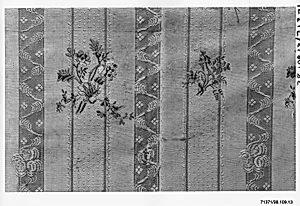
This exquisite silk fragment, woven in France during the mid-19 century, captures the opulent floral motifs—vibrant flowers and delicate—that defined European decorative arts of the era. Measuring 20½ x 8¾ inches, this delicate piece, now housed in the Metropolitan Museum of's Department of European Sculpture and Decor Arts, exemplifies the artistry of woven textiles. Donated in 1928 by Mrs. Leonard E. Opdy, it survives as a tantalizing remnant, likely from a larger textile like a gown, shawl, or upholstery, showcasing the period's love for nature-inspired patterns. In mid-19th-century France, silk weaving reached new heights of sophistication, particularly in Lyon, where innovations like the Jacquard loom enabled intricate, repeatable designs without manual labor. This fragment highlights such technical prowess: the silk's luster and fine weave create depth and movement in the floral elements, blending Romantic naturalism with emerging industrial precision. These textiles were cultural treasures, adorning the elite during the Second Empire under Napoleon III, symbolizing France's dominance in luxury goods. Though the artist remains unknown, the fragment's preservation underscores the fragility and value of textiles in art history. Visitors can appreciate how such works bridged fashion, interiors, and fine art, offering a window into 19th-century elegance and craftsmanship.