
Fragment
Unknown Artist
mid-16th century
Medium
Linen and wool
Dimensions
Overall: 6 3/4 x 4 in. (17.1 x 10.2 cm)
Classification
Textiles-Woven
Culture
Spanish
Department
European Sculpture and Decorative Arts
Museum
Metropolitan Museum of Art, New York, NY
Credit
Gift of H.A. Elsberg, 1928
Accession Number
28.180.3
Rights
Public Domain
Tags
Art Historical Context
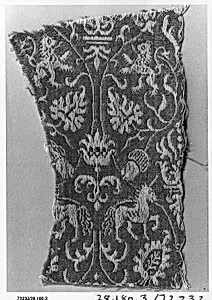
This exquisite *Fragment* from mid-16th-century Spain, woven from linen and wool, measures a modest 6 3/4 x 4 inches (17.1 x 10.2 cm). Though created by an unknown artist, it reveals the masterful craftsmanship of Spanish textile weavers during the Renaissance era. Delicate motifs of animals and flowers intertwine across its surface, evoking the natural world in vibrant, repeating patterns typical of the period's decorative arts. In 16th-century Spain, under the Habsburg monarchy, textiles like this were essential for clothing, furnishings, and ecclesiastical use, blending European traditions with lingering Islamic influences from the Mudéjar style. The use of linen for its fine weave and wool for warmth and colorfastness allowed for intricate designs that adorned everything from altar cloths to noble garments. As a surviving fragment, it hints at a larger, once-lavish piece, preserved as a testament to everyday artistry. Today, this treasure resides in the Metropolitan Museum of Art's Department of European Sculpture and Decorative Arts, a gift from H.A. Elsberg in 1928. It invites us to appreciate the anonymous hands that wove beauty into the fabric of history.