
Fragment
Unknown Artist
17th century
Medium
Needle lace, gros point lace
Dimensions
L. 25 1/2 x W. 3 1/2 inches (64.8 x 8.9 cm)
Classification
Textiles-Laces
Culture
Italian
Department
European Sculpture and Decorative Arts
Museum
Metropolitan Museum of Art, New York, NY
Credit
The Mabel Metcalf Fahnestock Collection, the gift of Ruth Fahnestock Schermerhorn and Faith Fahnestock, 1933
Accession Number
33.90.36
Rights
Public Domain
Art Historical Context
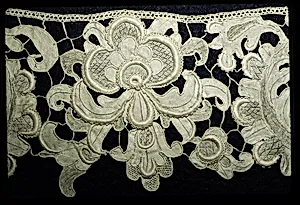
This exquisite *Fragment* of Italian needle lace from the 17th century the pinnacle of Baroque-era textile artistry. Crafted in gros point lace—a bold, geometric needle lace technique originating in Italy—this long, narrow strip (25½ x 3½ inches) likely served as ornamental border for elite garments, altar linens, or ecclesiastical vestments. During the 1600s, Venice and other Italian lace-making centers like Milan were renowned across Europe for their intricate punto in aria (needle lace) traditions, where threads were meticulously stitched in mid-air without a supporting fabric, creating delicate, sculptural effects that symbolized opulence and piety. The medium's significance lies in its labor-intensive process: skilled artisans, often women in convents or workshops, wove fine linen or silk threads into dense, raised patterns using a single needle. Gros point's chunky stitches allowed for dramatic motifs—possibly florals or scrolls here—evident in the fragment's preserved texture and precision. As a luxury good traded internationally, such laces adorned royalty and clergy, reflecting Italy's dominance in decorative arts amid the Counter-Reformation's emphasis on splendor. Generously donated to The Metropolitan Museum of Art in 1933 as part of The Mabel Metcalf Fahnestock Collection, this piece invites us to marvel at the anonymous maker's virtuosity, preserving a tactile glimpse into 17th-century craftsmanship.