
Fragment
Unknown Artist
18th century
Medium
Silk
Dimensions
a: 3 1/2 x 5 3/8 in. (8.9 x 13.7 cm) b: 21 1/2 x 4 in. (54.6 x 10.2 cm)
Classification
Textiles-Velvets
Culture
Italian
Department
European Sculpture and Decorative Arts
Museum
Metropolitan Museum of Art, New York, NY
Credit
Gift of Nanette B. Kelekian, in honor of Olga Raggio, 2002
Accession Number
2002.494.50a, b
Rights
Public Domain
Tags
Art Historical Context
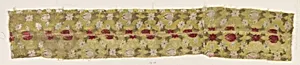
This exquisite silk velvet fragment from 18th-century Italy offers a tantalizing glimpse into the op world of European decorative arts. Comprising two pieces—one compact at 3 x 5⅜ inches and the other elongated at 21½ x 4 inches—the textile features delicate motifs of flowers and leaves, with the lustrous pile characteristic of fine velvet weaving. Produced in a era when Italian silk production thrived in cities like Genoa and Venice, this fragment likely originated from a larger garment upholstery, or ecclesiastical vestment, where such sumptuous materials symbolized wealth and status. Velvet's allure lies in its complex technique: silk warp threads are woven with extra weft yarns that are cut to create a soft, reflective pile, catching light to mimic the shimmer of jewels or petals. In the 18th century, floral designs like these echoed the naturalism of the Baroque and emerging Rococo styles, blending artistry with botanical precision. Though the artist remains unknown, the fragment's survival highlights the craftsmanship of anonymous Italian weavers, whose innovations influenced fashion across Europe. Generously gifted to The Metropolitan Museum of Art in 2002 by Nanette B. Kelekian in honor of curator Olga Raggio, this piece resides in the European Sculpture and Decorative Arts department. It invites us to appreciate how everyday luxuries once adorned grand interiors, preserving a whisper of Italy's textile legacy for modern eyes.