
Fragment
Unknown Artist
late 16th century
Medium
Silk
Dimensions
Overall: 3 3/4 x 10 3/4 in. (9.5 x 27.3 cm)
Classification
Textiles-Woven
Culture
Italian
Department
European Sculpture and Decorative Arts
Museum
Metropolitan Museum of Art, New York, NY
Credit
Gift of Nanette B. Kelekian, in honor of Olga Raggio, 2002
Accession Number
2002.494.217
Rights
Public Domain
Art Historical Context
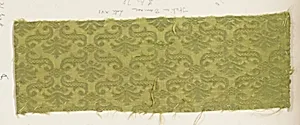
This delicate silk fragment, woven in late 16th-century Italy, offers a glimpse into the opulent world of Renaissance textiles. Measuring just 3 3/4 x 10 3/4 inches, it survives as a precious remnant, likely from a larger textile such as a garment, ecclesiastical vestment, or luxurious furnishing. Produced during a golden age of Italian craftsmanship, when cities like Florence and Venice dominated Europe's silk trade, this piece exemplifies the era's mastery of woven silks imported from the East and transformed through local ingenuity. The medium—pure silk—highlights advanced weaving techniques that allowed for intricate patterns and rich sheen, making such fabrics status symbols among nobility and clergy. Though the artist remains unknown, the fragment's classification as a woven textile underscores Italy's pivotal role in decorative arts, bridging Eastern luxury goods with Western design innovation. Its survival speaks to the durability and value of these materials, often repurposed over centuries. Generously gifted to the Metropolitan Museum of Art in 2002 by Nanette B. Kelekian in honor of Olga Raggio, this fragment invites visitors to appreciate the tactile elegance of Renaissance splendor, reminding us how everyday luxuries shaped cultural history.