
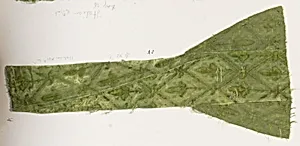
Fragment
Unknown Artist
16th century
Medium
Silk
Dimensions
Overall: 16 x 7 5/8 in. (40.6 x 19.4 cm)
Classification
Textiles-Velvets
Culture
Italian
Department
European Sculpture and Decorative Arts
Museum
Metropolitan Museum of Art, New York, NY
Credit
Gift of Nanette B. Kelekian, in honor of Olga Raggio, 2002
Accession Number
2002.494.239
Rights
Public Domain
Art Historical Context
This exquisite silk velvet fragment, hailing from 16th-century Italy, a tantalizing glimpse into the Renaissance era's opulent textile artistry. Measuring 16 x 7 5/8 inches (40.6 x 19.4 cm), it survives as a precious remnant, likely from a larger garment, ecclesiastical vestment, or luxurious furnishing. Displayed in the Metropolitan Museum Art's Department of European Sculpture and Decor Arts—thanks to a 2002 gift from Nan B. Kelekian in honor of Olga Raggio—it exemplifies the pinnacle of Italian weaving craftsmanship. In Renaissance Italy, cities like Venice, Florence, and Genoa were renowned for producing sumptuous velvets, prized across Europe for their rich texture and vibrant dyes. Silk velvet, created through intricate cut-pile techniques, created a lustrous sheen that caught the light dramatically, symbolizing wealth and status. These textiles were exported widely, adorning nobility and enhancing interiors with their tactile luxury. Though the artist remains unknown, this fragment's survival underscores the fragility and enduring allure of such materials. It invites visitors to imagine its original splendor, reflecting Italy's pivotal role in the decorative arts during a time of artistic and economic flourishing.