
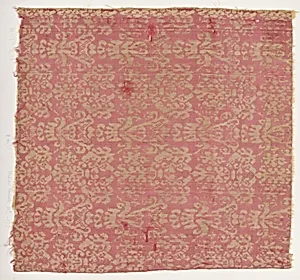
Fragment
Unknown Artist
16th–17th century
Medium
Silk
Dimensions
Overall: 18 3/4 x 17 7/8 in. (47.6 x 45.4 cm)
Classification
Textiles-Woven
Culture
Italian
Department
European Sculpture and Decorative Arts
Museum
Metropolitan Museum of Art, New York, NY
Credit
Gift of Nanette B. Kelekian, in honor of Olga Raggio, 2002
Accession Number
2002.494.289
Rights
Public Domain
Art Historical Context
This exquisite silk fragment, woven in Italy during the 16 or 17th century, offers a tantalizing glimpse into the opulent world of Renaissance and Baroque decorative arts. Measuring 18¾ x 17⅞ inches (47.6 x 45.4 cm), it survives as a testament to the mastery of Italian textile artisans, who were among Europe's finest. Housed in the Metropolitan Museum of Art's Department of European Sculpture and Decor Arts, this piece was generously gifted by Nanette B. Kian in honor of Olgaaggio in 2002Silk weaving reached extraordinary heights in Italy during this era, with cities like Venice, Florence, and Genoa serving as hubs for luxurious fabrics traded along the Silk Road and produced with innovative looms. The medium's sheen and durability made it ideal for ecclesiastical vestments, aristocratic garments, and lavish furnishings, symbolizing wealth and piety. Though the exact design is fragmented, its preservation highlights the fragility of such textiles, which often deteriorated from use or environmental factors. As a classified woven textile, this fragment embodies the technical prowess of lampas or velvet techniques, where silk warps and wefts created intricate patterns and rich textures. For visitors, it evokes the sensory splendor of Italy's Golden Age, inviting reflection on how everyday luxuries shaped cultural identity and artistic exchange across Europe.