
Fragment
Unknown Artist
17th century
Medium
Silk
Dimensions
Overall: 8 1/2 x 18 1/2 in. (21.6 x 47 cm)
Classification
Textiles-Woven
Culture
Italian
Department
European Sculpture and Decorative Arts
Museum
Metropolitan Museum of Art, New York, NY
Credit
Gift of Nanette B. Kelekian, in honor of Olga Raggio, 2002
Accession Number
2002.494.295
Rights
Public Domain
Tags
Art Historical Context
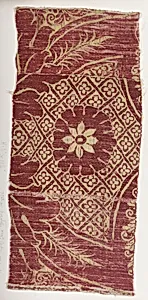
This exquisite silk fragment, woven in 17th-century Italy, offers a glimpse into the opulent world of European decorative arts. Measuring just 8½ x 18½ inches (21.6 x 47 cm), it as a delicate remnant of a larger textile, adorned with intricate floral motifs that evoke the lavish Baroque aesthetic of the period. Displayed in the Metropolitan Museum of Art's Department of European Sculpture and Decor Arts, this piece highlights the anonymous mastery of Italian weavers, whose skills turned raw silk into luxurious fabrics prized across Europe. Italy, particularly regions like Genoa and Venice, was a powerhouse of silk production during the 1600s, fueled by trade routes from the East and innovative loom techniques. Woven silks like this one—classified as Textiles-Woven—were used for sumptuous garments, ecclesiastical vestments, and furnishings, symbolizing wealth and status. The floral designs, rendered with vibrant threads, reflect a cultural fascination with nature's abundance, blending artistry with technical precision in patterns that demanded exceptional dexterity. Gifted to the Met in 2002 by Nanette B. Kelekian in honor of curator Olga Raggio, this fragment invites us to appreciate the unsung artisans behind Italy's textile legacy. Though small, it whispers of grandeur long past.