
Fragment
Unknown Artist
16th century
Medium
Silk, metal thread
Dimensions
Overall: 16 3/8 x 7 3/4 in. (41.6 x 19.7 cm)
Classification
Textiles-Woven
Culture
Italian
Department
European Sculpture and Decorative Arts
Museum
Metropolitan Museum of Art, New York, NY
Credit
Gift of Nanette B. Kelekian, in honor of Olga Raggio, 2002
Accession Number
2002.494.347
Rights
Public Domain
Art Historical Context
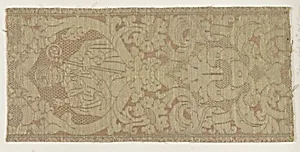
This exquisite *Fragment* from 16th-century Italy showcases the opulence of Renaissance textile arts. Woven from luxurious silk and shimmering metal threads, the piece measures 16⅜ × 7¾ inches (41.6 × 19.7 cm) and survives as a testament to the era's masterful craftsmanship. Housed in the Metropolitan Museum of Art's Department of European Sculpture and Decor Arts, it was generously gifted by Nanette B. Kian in honor of Olgaaggio in 2002In Renaissance Italy, particularly in weaving centers like Venice and Florence, silk textiles enriched with metal threads—often gold or silver—were symbols of wealth and piety. These fabrics adorned ecclesiastical vestments, noble garments, and furnishings, their intricate patterns catching light to evoke divine splendor. The use of metal threads in weaving techniques such as brocading added durability and a jewel-like gleam, reflecting advanced looms and dye technologies of the time. Though the artist remains unknown, this fragment highlights Italy's pivotal role in Europe's luxury trade, bridging art and commerce during a golden age of innovation. Visitors can appreciate how such textiles blurred the line between decoration and devotion, preserving a slice of 16th-century grandeur.