
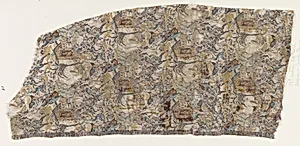
Fragment
Unknown Artist
19th century
Medium
Silk
Dimensions
Overall: 18 3/4 x 8 5/8 in. (47.6 x 21.9 cm)
Classification
Textiles-Woven
Culture
European
Department
European Sculpture and Decorative Arts
Museum
Metropolitan Museum of Art, New York, NY
Credit
Gift of Nanette B. Kelekian, in honor of Olga Raggio, 2002
Accession Number
2002.494.450
Rights
Public Domain
Art Historical Context
This delicate silk fragment, woven in 19th-century Europe, offers a glimpse into the opulent world of textile artistry. Measuring 18¾ x 8⅝ inches (47.6 x 21.9 cm), it survives as a testament to the era's masterful weaving techniques, where silk—prized for its luster and durability—was transformed into luxurious fabrics for garments, furnishings, and ecclesiastical vestments. Classified among the Metropolitan Museum of Art's European Sculpture and Decorative Arts, this piece highlights the intricate loom work that defined woven textiles, often featuring complex patterns born from mechanical innovations like the Jacquard loom. In the 19th century, European silk production flourished in hubs such as Lyon, France, and Spitalfields, England, blending traditional handcraft with industrial advances. These textiles symbolized wealth and cultural refinement, adorning homes of the elite and reflecting broader shifts toward mass-produced elegance amid the Industrial Revolution. Though the artist remains unknown and the fragment's original context—perhaps from a larger tapestry or garment—is lost, its preservation underscores the enduring value of such ephemeral arts. Generously donated in 2002 by Nanette B. Kelekian in honor of Olga Raggio, a distinguished curator, this fragment invites us to appreciate the subtle beauty of everyday luxury. At the Met, it reminds visitors of textiles' role as both functional art and historical artifact.